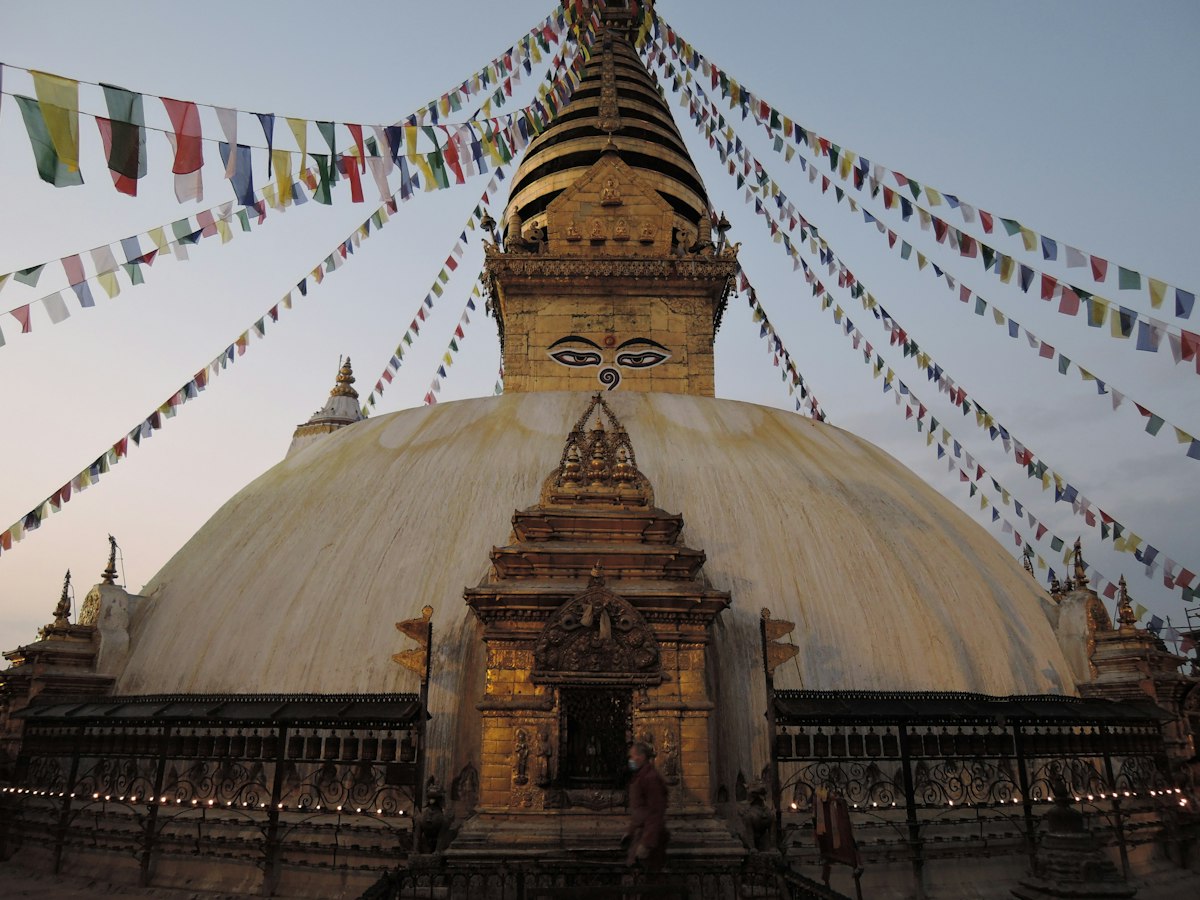
Three days in the Kathmandu Valley is enough to experience three UNESCO World Heritage Durbar Squares, ancient Buddhist and Hindu temples, Newari architecture spanning 2,000 years, and some of the best food in South Asia — all within a 30-kilometre radius. Day one covers Kathmandu's temples and Thamel, day two takes you to Patan's exquisite metalwork and Boudhanath's giant stupa, and day three explores medieval Bhaktapur and the hilltop views of Nagarkot. Here is the complete day-by-day plan.
Day 1: What Should You See in Kathmandu City?
Day one focuses on central Kathmandu — the old royal palace, the great temples, and the vibrant tourist quarter. Start early to beat both the heat and the crowds.
Morning (7:00 AM – 12:00 PM):
7:00 AM — Swayambhunath (Monkey Temple) Begin at Swayambhunath, the 2,500-year-old hilltop stupa that overlooks the entire Kathmandu Valley. Arrive early for the best light and fewer tourists. Climb the 365 stone steps (or take a taxi to the back entrance if steps are not appealing). The panoramic valley views are spectacular, especially before the morning haze sets in.
- Entry: NPR 200 (foreigners), free for SAARC nationals
- Time needed: 1–1.5 hours
- Tip: Watch out for the monkeys — they will grab food, sunglasses, and anything shiny
9:00 AM — Kathmandu Durbar Square Take a taxi (NPR 300-400) or Pathao ride to the old royal palace square. Despite the 2015 earthquake damage, Durbar Square remains magnificent. Key sights: Hanuman Dhoka Palace, Kumari Ghar (home of the Living Goddess — if lucky, you may see her appear at the window), Kasthamandap (the wooden pavilion that gave Kathmandu its name, rebuilt after the earthquake), and the towering Taleju Temple.
- Entry: NPR 200 (SAARC), NPR 1,000 (others). Keep the ticket — it is valid for the duration of your visa with a free extension at the ticket office.
- Time needed: 1.5–2 hours
- Tip: Hire a local guide at the entrance (NPR 1,000-1,500) for context that transforms random temples into stories
11:00 AM — Asan and Indra Chowk Market Walk Walk north from Durbar Square through the old bazaar streets of Asan and Indra Chowk. This is Kathmandu at its most alive — spice vendors, flower sellers, bead markets, metalworkers, and narrow lanes packed with motorcycles and pedestrians. Buy a cup of chiya (NPR 20) and watch the city flow.
- No entry fee
- Time needed: 45 minutes – 1 hour
Afternoon (12:00 PM – 5:00 PM):
12:30 PM — Lunch in Thamel Return to Thamel for lunch. Recommendations:
- Thakali Kitchen — Authentic Thakali thali (NPR 350-450)
- Yangling Tibetan Restaurant — Giant momos and thukpa (NPR 200-400)
- Fire and Ice Pizzeria — Surprisingly excellent Italian, a Thamel institution (NPR 500-800)
2:00 PM — Pashupatinath Temple Take a taxi (NPR 400) to Pashupatinath, the holiest Hindu temple in Nepal and a UNESCO World Heritage Site. Non-Hindus cannot enter the main temple, but you can observe the cremation ghats on the Bagmati River, explore the surrounding forests, and visit the smaller temples and ashrams. This is a profound, confronting, and deeply spiritual experience.
- Entry: NPR 1,000 (foreigners), free for SAARC nationals
- Time needed: 1.5–2 hours
- Dress code: Respectful attire (no shorts, cover shoulders)
- Photography: Permitted in the temple complex but be respectful around cremation areas
4:30 PM — Garden of Dreams End the day at the Garden of Dreams (Swapna Bagaicha), a neoclassical European garden hidden behind Thamel's chaos. It is the perfect decompression spot after a full day of temples and markets. Have a cold drink at the garden cafe and rest your feet.
- Entry: NPR 200
- Time needed: 45 minutes – 1 hour
Evening: Dinner in Thamel. Try Places Restaurant for Nepali-fusion or New Orleans Cafe for live music and cocktails. Thamel comes alive after dark — bookshops, handicraft stores, and trekking gear shops stay open until 9-10 PM.
Day 2: How Do You Explore Patan and Boudhanath?
Day two splits between Patan (the City of Fine Arts) and Boudhanath (the great Buddhist stupa). Both are within Kathmandu but feel like different worlds.
Morning (8:00 AM – 12:30 PM):
8:00 AM — Patan Durbar Square Take a taxi (NPR 500-600) or Pathao ride to Patan, 5 kilometres south of Thamel. Patan Durbar Square is arguably the finest of the three valley Durbar Squares — more compact, more intricate, and less damaged by the earthquake.
Key sights:
Patan Museum — One of South Asia's best museums, housed in a former palace. The metalwork, wood carving, and bronze casting exhibits are extraordinary. Allow 1-1.5 hours.
Krishna Temple — A 17th-century stone temple with stunning carvings of scenes from the Mahabharata
Golden Temple (Hiranya Varna Mahavihar) — A hidden Buddhist monastery behind the square, dripping with gold leaf and intricate metalwork. NPR 50 entry.
Mahabouddha Temple — A terracotta tower covered in thousands of tiny Buddha images. Down a narrow lane south of the square.
Entry: NPR 200 (SAARC), NPR 1,000 (others)
Museum entry: NPR 250 (SAARC), NPR 600 (others)
Total time needed: 2.5–3 hours
11:00 AM — Patan Backstreets Walk Wander the lanes around the square. Patan is the centre of Nepal's traditional metalwork — you will find workshops where artisans create the same bronze statues and singing bowls using techniques unchanged for centuries. Watch craftsmen at work, buy a handmade singing bowl (NPR 1,500-5,000), or simply admire the ornate window frames and door lintels on Newari houses.
Afternoon (12:30 PM – 6:00 PM):
12:30 PM — Lunch at Patan
- Cafe Swotha — Inside a beautifully restored Newari building, seasonal Nepali cuisine, NPR 400-700
- Honacha — Authentic Newari food in a traditional setting, NPR 300-500
2:00 PM — Boudhanath Stupa Taxi from Patan to Boudhanath (NPR 500-600, 20 minutes). Boudhanath is one of the largest Buddhist stupas in the world — a massive white dome crowned with the all-seeing eyes of the Buddha, surrounded by a mandala of monasteries, prayer wheels, and Tibetan shops.
Walk clockwise around the stupa (as is tradition) and join the hundreds of devotees spinning prayer wheels and chanting mantras. The atmosphere is meditative and hypnotic, especially as the late afternoon light catches the golden spire.
- Entry: NPR 400 (foreigners), free for SAARC nationals
- Time needed: 1.5–2 hours
- Tip: Visit a rooftop cafe overlooking the stupa — Stupa View Restaurant offers the best vantage point with a cold beer or butter tea
4:00 PM — Explore Boudhanath Monasteries Several Tibetan Buddhist monasteries around the stupa are open to visitors:
- Shechen Monastery — Beautiful murals, active monk community, peaceful courtyards
- Ka-Nying Shedrub Ling — Morning prayer sessions open to visitors (best experienced early morning)
- Entry: Free (donations appreciated)
Evening: Return to Thamel for dinner. Consider a rooftop restaurant like Rosemary Kitchen or Dhokaima Cafe in Patan if you want to stay south.
Day 3: Is Bhaktapur Worth a Full Day?
Absolutely. Bhaktapur is the best-preserved medieval city in Nepal — a living museum of Newari architecture, pottery, weaving, and food. It deserves a full day, ideally combined with a late afternoon drive to Nagarkot for sunset mountain views.
Morning (7:30 AM – 12:30 PM):
7:30 AM — Bus or Taxi to Bhaktapur Take a local bus from Ratnapark (NPR 40, 45 minutes) or a taxi (NPR 1,000-1,500, 30 minutes). Arrive early — Bhaktapur is magical in the morning before the tour groups arrive.
8:00 AM — Bhaktapur Durbar Square The most spacious and visually dramatic of the three valley squares. Key sights:
55-Window Palace — A masterpiece of Newari wood carving, with 55 intricately carved windows along the upper floor
Vatsala Temple — Famous for its stone bell, the "Bell of Barking Dogs" (it makes dogs howl when rung)
Nyatapola Temple — The tallest pagoda in Nepal, a five-storey masterpiece guarded by stone figures of increasing strength on each level
Entry: NPR 500 (SAARC), NPR 1,500 (others). This single ticket is valid for the duration of your visa and covers all Bhaktapur sites.
Time needed: 1.5 hours
9:30 AM — Taumadhi Square and Pottery Square Walk south to Taumadhi Square (home to Nyatapola) and then east to Pottery Square, where artisans throw clay pots on traditional wheels and lay them out to dry in the sun. In winter and spring, the square is a sea of terracotta pots. Wonderful for photography.
10:30 AM — Juju Dhau and Street Food Bhaktapur is the food capital of the valley. Must-eat:
- Juju Dhau (King of Yoghurt) — Creamy, sweet, set yoghurt served in a clay pot. NPR 50-80. This alone is worth the trip.
- Bara and Chatamari — Newari snacks from street vendors. NPR 30-50 each.
- Yomari (if in season) — Sweet steamed dumplings. A Bhaktapur specialty.
11:00 AM — Dattatraya Square and Peacock Window Walk through the old lanes to Dattatraya Square, a quieter square with the ancient Dattatraya Temple. Nearby, find the famous Peacock Window — Nepal's most celebrated piece of wood carving, a 15th-century window depicting a peacock with spread tail feathers. It is on the facade of a building in a narrow lane — easy to miss, so ask locals for directions.
Afternoon (12:30 PM – 6:30 PM):
12:30 PM — Lunch in Bhaktapur
- Sunny Restaurant (Taumadhi Square) — Rooftop with Nyatapola Temple views, Newari food, NPR 300-500
- King's Restaurant — Near Durbar Square, dal bhat and momos with temple views
2:00 PM — Changu Narayan Temple (Optional) If you have the energy, take a local bus or taxi (NPR 500, 20 minutes) to Changu Narayan, the oldest Hindu temple in the valley (4th century AD). Set on a hilltop with valley views and extraordinary stone carvings. This is a UNESCO site that most tourists skip — you will likely have it to yourself.
- Entry: Included in Bhaktapur ticket
- Time needed: 1 hour
4:00 PM — Drive to Nagarkot From Bhaktapur, hire a taxi (NPR 1,500-2,000, 40 minutes) up to Nagarkot, a ridge-top village at 2,175 metres with panoramic Himalayan views stretching from Dhaulagiri to Everest on clear days. The sunset view over the mountains is spectacular.
Option A — Sunset and return: Watch the sunset from the Nagarkot Tower viewpoint and return to Kathmandu the same evening (taxi NPR 2,000-2,500 back to Thamel).
Option B — Stay overnight: Book a hotel in Nagarkot for the sunrise, which is even more spectacular than sunset. Search Nagarkot hotels on BookGarum. The next morning sunrise (5:30-6:30 AM depending on season) over the Himalayas is an experience you will not forget.
How Much Does the 3-Day Kathmandu Valley Trip Cost?
Here is a complete budget breakdown per person:
| Item | Budget (NPR) | Mid-Range (NPR) | Comfort (NPR) |
|---|---|---|---|
| Accommodation (3 nights) | 3,000–4,500 | 7,500–12,000 | 15,000–30,000 |
| Entry fees | 1,500–2,000 | 1,500–2,000 | 1,500–2,000 |
| Food (3 days) | 2,500–3,500 | 4,500–7,500 | 8,000–15,000 |
| Transport | 1,500–2,500 | 3,000–5,000 | 5,000–8,000 |
| Guides/tips | 0–500 | 2,000–3,000 | 3,000–5,000 |
| Total | 8,500–13,000 | 18,500–29,500 | 32,500–60,000 |
In Indian Rupees: Budget ~INR 5,300-8,100, Mid-range ~INR 11,500-18,400, Comfort ~INR 20,300-37,500.
What Practical Tips Make This Itinerary Better?
Getting around:
- Use Pathao or inDrive app for taxis — cheaper and more transparent than street taxis
- Local buses are extremely cheap (NPR 15-40) but confusing. Ask your hotel to write your destination in Nepali.
- Walking within Durbar Squares is the only option — no vehicles allowed
Best time to visit:
- October–November (clear skies, festival season, warm days)
- March–April (spring flowers, good visibility, warm)
- Avoid June–August (monsoon rain obscures mountain views)
Photography tips:
- Early morning light (7:00-9:00 AM) is best for temple photography
- Bhaktapur sunrise and Nagarkot sunrise are both exceptional
- Ask permission before photographing sadhus — they expect a small tip (NPR 50-100)
- Drone regulations: Technically requires a permit from the Civil Aviation Authority. In practice, enforcement is inconsistent, but Durbar Squares and religious sites are strict no-fly zones.
Respect local customs:
- Remove shoes before entering any temple
- Walk clockwise around Buddhist stupas and monuments
- Do not touch offerings or religious items
- Dress modestly (cover knees and shoulders) at religious sites
- Photography of cremation ceremonies at Pashupatinath is a sensitive topic — be discreet and respectful
Where to stay for this itinerary:
- Thamel (Kathmandu) is the best base for days 1 and 2 — walking distance to restaurants, close to taxi stands
- Bhaktapur is an alternative base — quieter, more atmospheric, but fewer dining options
- Nagarkot for the final night if you want the sunrise experience
Search Kathmandu Valley hotels on BookGarum →
Related reads: